Calibration
One of the advantages of spICP-MS is its ability to calculate the size and mass distribution of particles. This is performed by calibrating particle signals (in counts) to mass using the instrument ionic response, and then to size using a known particle density.
The transport efficiency is the fraction of sample that makes it through to detection and must also be determined before calibration can occur. With the exception of total-consumption nebulisers (100% efficiency) it is typically 0.02 - 0.1 (2 - 10%). The transport efficiency (\(\eta\)) can be entered manually if known (see Pace et al. [1] for examples), or calculated based on the response of a well characterised reference particle.
The method used in SPCal can be selected in the Edit -> Processing Options dialog. A full description of the calibration methods used in SPCal is available in a previous publication [2] .
Reference Particle
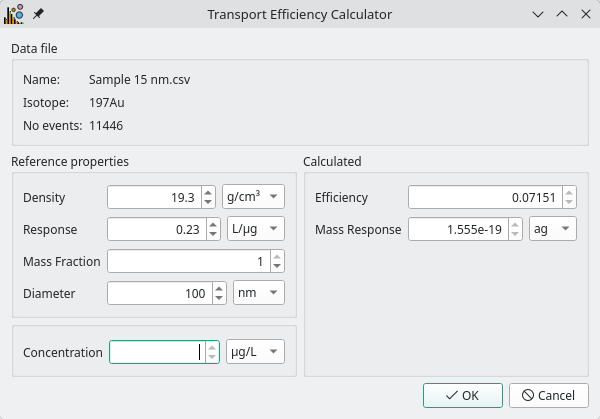
Fig. 13 The Transport Efficiency Calculator is enabled once particles are detected and a instrument iptake rate is input.
To calculate transport efficiency using a reference particle first load the data into SPCal, see Data Import. Then input the instrument uptake to enable the efficiency calculator button, next to the Trans. Efficiency input. Clicking this button opens the calculator in Fig. 13 using the currently selected data file and isotope.
To correctly calibrate, the particle density, ionic response, diameter must be entered into the calculator. Ideally a particle of a single element is used, if one containing multiple is used then the mass fraction of the measured element must be entered. If the mass concentration of the reference particle solution is known then the accuracy of the calculation will be greater. Once all parameters are input, click OK to apply the efficiency top the instrument method.
The transport efficiency is usually assumed to be independent of mass and a single element can be used to calibrate the entire mass range.
Mass Response
Limited calibration can also occur with the transport efficiency by determining the mass response from a reference particle. Using the mass response eliminates the need for instrument uptake and ionic response but can only calibrate signals into masses.